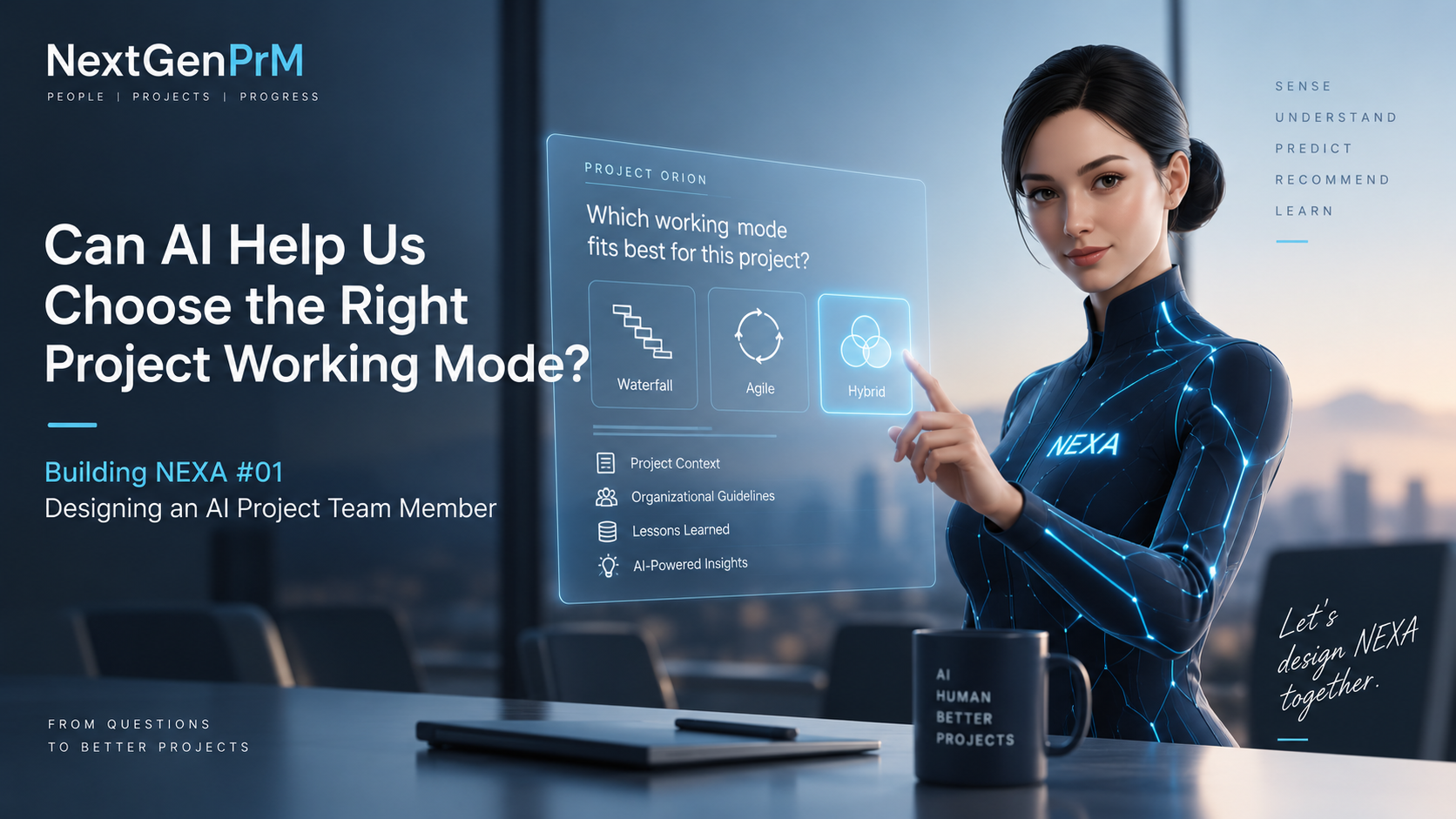
One of the first important decisions when starting a project is deceptively simple:
How should we actually run this project?
Waterfall? Agile? Hybrid?
In many organizations, this question appears somewhere around the kick-off meeting or during the first team discussions. And for years, it has also been one of the most debated topics in the project management world.
Agile advocates, traditional project managers, hybrid supporters, skeptics — we have seen methodologies, frameworks, transformation programs, pilots and countless discussions around the “best” way to manage a project.
After experiencing this discussion both theoretically and practically, my conclusion is probably the most classic consulting answer imaginable: It depends.
Sometimes, when doctors cannot immediately identify the exact cause of a symptom, we hear: “It might be stress.” In project management, our version sometimes sounds like: “Which methodology should we use?” — “Well… it depends.”
But in this case, it really does.
There is no universal “best” project methodology
The appropriate project management approach depends on many signals: project type, maturity of requirements, level of uncertainty, expected deliverables, regulatory constraints, organizational structure, decision-making mechanisms, team locations, stakeholder complexity and available resources.
But the list quickly becomes much longer. What is the experience level of the project team? How stable is the scope? How quickly do we expect requirements to change? How tightly are hardware, software, industrialization or supplier activities interconnected? How mature is the organization in Agile ways of working? How often can customers or stakeholders provide meaningful feedback? How expensive is a late change?
This is why I am increasingly skeptical of one-size-fits-all project management models. The goal should not be to make every project Agile, Waterfall or Hybrid. The goal should be to understand the characteristics of the project and design the most appropriate operating model for that specific situation.
Could AI help us make this decision better?
Evaluating all these variables is not trivial. It normally requires experience, organizational knowledge, project management expertise and the ability to recognize patterns from previous projects.
This is the hypothesis behind NEXA — NextGen Project Intelligence Agent.
Meet NEXA — or perhaps, let’s design NEXA
There is an important distinction: NEXA does not exist as a finished product — at least not yet.
What you see in the storyboard and video is a conceptual prototype. It is a way of visualizing what an AI project team member could look like, what capabilities it would need, what data and knowledge it should understand, and where the boundaries between AI intelligence and human judgement should remain.
So rather than presenting NEXA as an existing solution, I want to use this series as an open design experiment.
What should it know? What should it be able to do? And what should it never decide?
Let’s design NEXA together.
Use Case #1 — Choosing the Project Working Mode
For our first practical use case, I asked our fictional NEXA to help a fictional project team answer a very real question: What is the most appropriate working mode for Project Orion?
But before NEXA can give us a meaningful answer, there is an important prerequisite.
What would NEXA need to know?
Giving an AI system a project description and asking “Should we use Agile?” will probably produce a polished answer. But polished is not the same as useful.
If we want an AI team member to provide context-specific, actionable recommendations, it needs access to several layers of knowledge.
1. Project management knowledge
NEXA should understand established project management methods, tools and practices: Agile, Waterfall and Hybrid models; planning methods; risk management; stakeholder management; governance; communication models; portfolio and program principles. Much of this knowledge is already widely available.
2. Organizational knowledge
Every organization has its own operating system: internal guidelines, governance requirements, approval processes, mandatory milestones, official tools, reporting structures, roles and responsibilities, and regulatory constraints.
An approach that works perfectly in one company may simply be impossible in another. NEXA therefore needs to understand not only project management, but how project management actually works inside the organization.
3. Organizational structure and decision logic
Who makes which decisions? Which steering committees exist? How are resources allocated? Where are functional responsibilities located? How do global and local teams interact? Which decisions require formal approval?
4. Project-specific context
NEXA needs to understand the project objective, expected outcome, timeline, scope maturity, product architecture, dependencies, resources, stakeholders, uncertainties and constraints. Without this layer, any methodology recommendation remains theoretical.
5. Experience — the organization’s project memory
This may be the most valuable layer of all. An experienced project leader does not make decisions using methodology books alone. Experience matters.
This is where Lessons Learned could become much more than archived documents. In an AI-powered project organization, they could become organizational project memory.
Imagine NEXA being able to ask: What happened in projects with similar supplier structures? Where did previous Hybrid projects struggle? Which risks repeatedly appeared during industrialization? Which working mode produced better outcomes for similar project characteristics?
Organizations that systematically build and structure this knowledge today may be creating one of their most valuable AI assets for tomorrow.
Project Orion: What could NEXA actually do?
For this thought experiment, let’s assume NEXA has access to these knowledge layers. The storyboard below shows how such an AI project team member could support Project Orion.
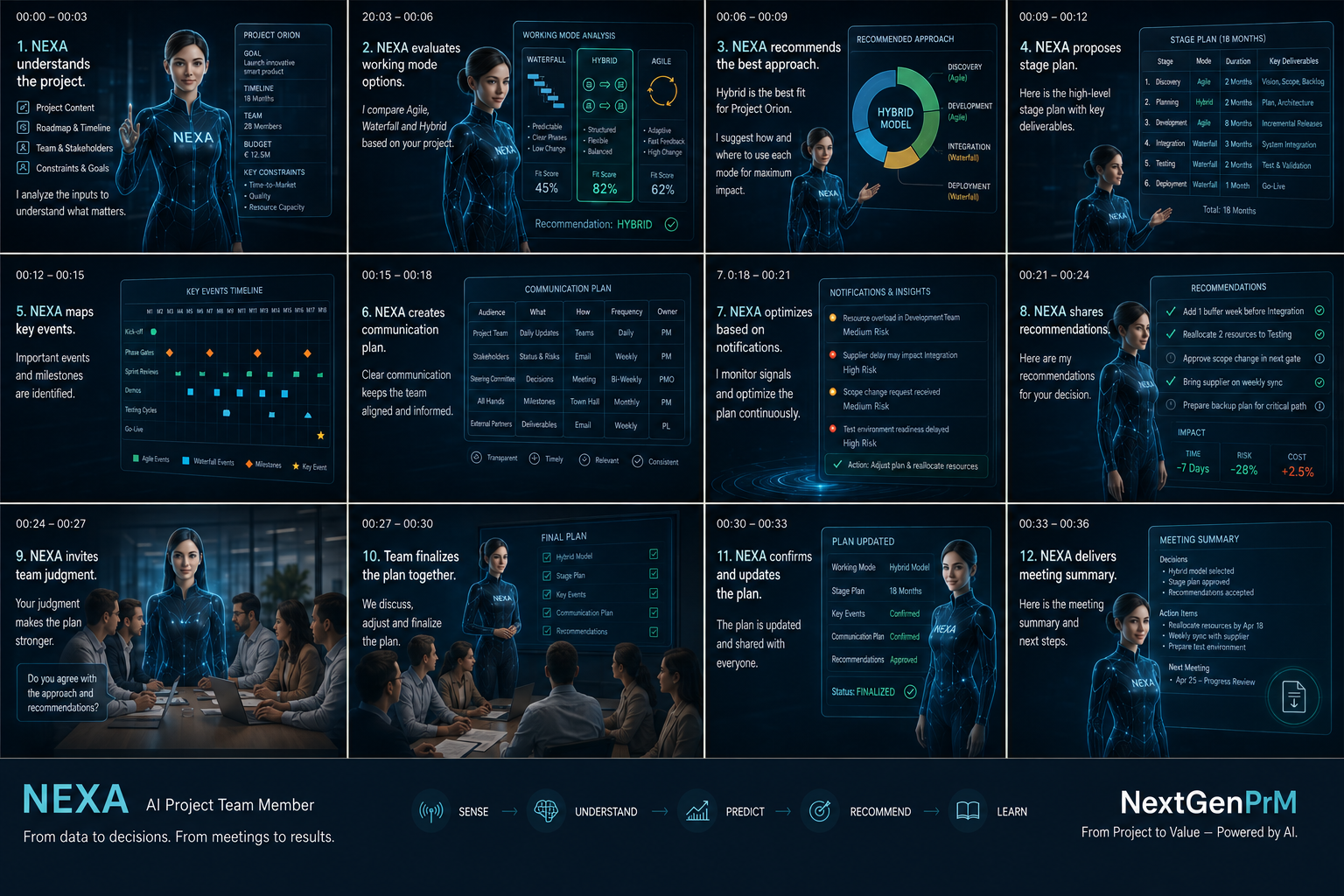
So what role is NEXA actually playing?
During this single use case, NEXA already moves between several roles: project analyst, methodology advisor, project coordinator, planning assistant, risk analyst, PMO analyst, governance navigator, meeting facilitator and knowledge curator.
It could partially support capabilities we currently associate with Agile Coaches, Scrum Masters, Project Controllers, PMO Analysts, Risk Managers, Project Coordinators, Governance Advisors, Knowledge Managers and Decision-Support Analysts.
Not necessarily by replacing these professions, but by absorbing parts of the information-processing workload around them.
The future may not be AI Project Manager versus Human Project Manager. It may be a project team where humans bring leadership, negotiation, accountability, creativity and judgement — while AI continuously provides context, analysis, memory and predictive intelligence.
Building NEXA — together
NEXA is still a concept, not a finished solution. That is exactly why I find this experiment interesting.
Rather than starting with a technology and looking for a problem, I want to start with real project-management challenges and ask what an AI project team member would need in order to contribute meaningfully.
One use case at a time, we can design the capabilities, knowledge architecture, interfaces and — equally important — the boundaries.
What should NEXA know? What should NEXA do? What should remain firmly with the human project team?
Ümit Gokoglu · Creator of NextGenPrM
Exploring AI-Powered Project Management & the Future of Project Organizations
NextGenPrM — From Project to Value. Powered by AI.
NEXA doesn't manage the project. NEXA understands the project.
AI brings intelligence. Humans bring judgement.